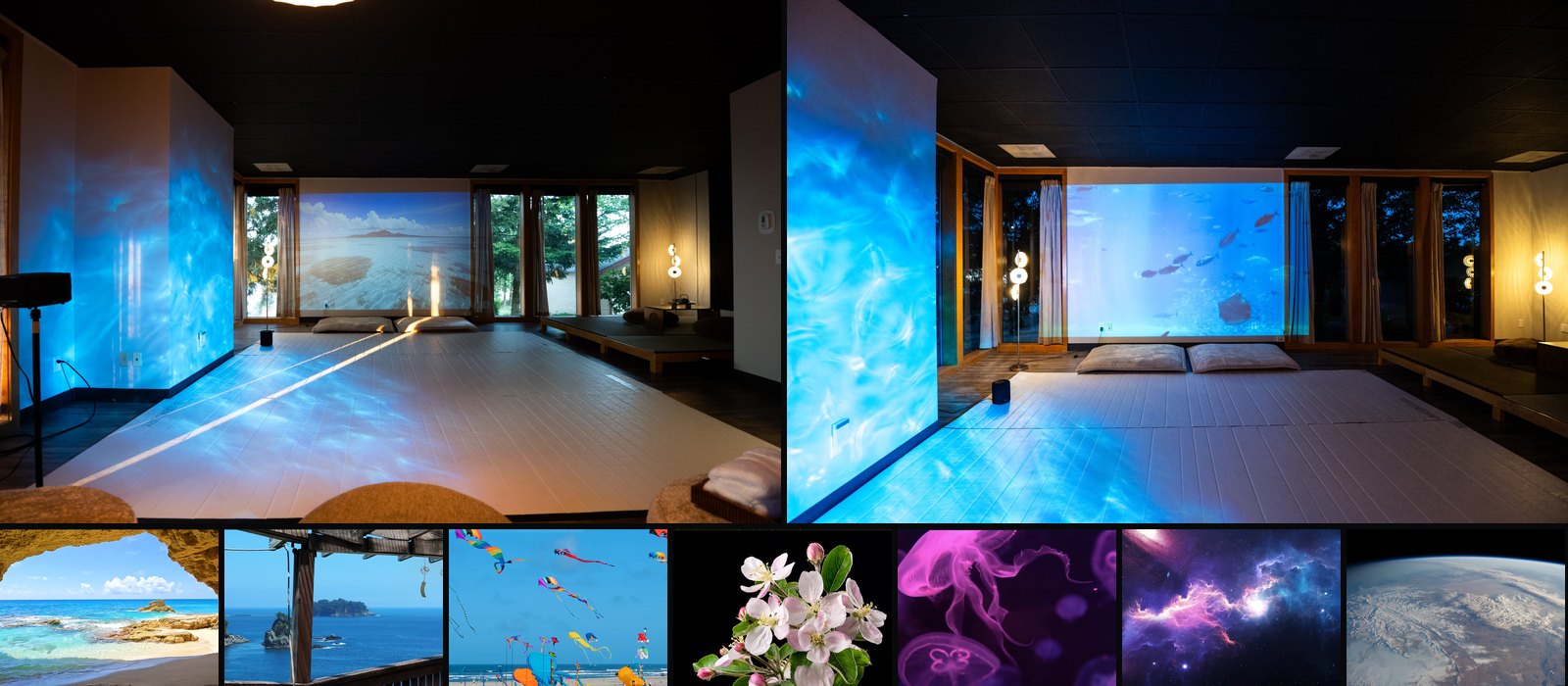
Silence, no strangers. Make the 1,000 sqft studio private with a call button I answer. Move from shared rhythm into active synchronization, inside an atmosphere you choose together.
A typical moment together
–Time together can remain divided between individual thoughts, stress, and responsibilities
–Conversation or activities can leave each person focused in a different place
–Each person can remain absorbed in their own internal state
–Being together does not always bring attention and physiology into the same rhythm
This experience
·Begin from a shared state of physical calm
·Follow the same guided respiratory rhythm
·Coordinate attention, breathing, and timing with one another
·You choose the environment together
·A personally meaningful song can culminate the experience through shared memory and emotion
Shared rhythm
immersive atmosphere
synchronized respiratory pacing
cardiorespiratory coupling
reciprocal regulation
mutual attunement
=Mutual attunement
What you may experience
·Greater awareness of one another
·Shared attention and presence
·A stronger sense of being in sync
·Greater emotional availability
·Deeper emotional presence
·A stronger sense of closeness and togetherness
Best for: couples who want to practice synchronization, mutual attention, emotional availability, and deeper attunement, in a setting made for the two of you.
For $65 moreAdd it when you bookChoose the 45-minute session, then add Mind Reset in the add-ons. It adds 30 minutes, so your visit runs 75 minutes in all.
Member 20% offAdd-ons for two: steam towel set · spa robe & lounge set · socks
Vibroacoustic Therapy (VAT) is a therapeutic method that uses low-frequency, sinusoidal sound waves to transmit vibration directly into the body through specialized transducers. In this approach, the sine wave itself is the therapeutic stimulus.
Today, VAT is a recognized complementary therapeutic modality with a growing body of clinical experience and scientific research. Its defined methodology and decades of development provide a foundation for practitioners using sound and vibration as therapeutic tools.
The sound is converted by transducers into mechanical vibration, allowing frequencies to be experienced directly through the body. Frequency, intensity, modulation, and duration can be precisely controlled. VAT has been used and studied in relation to relaxation, stress regulation, pain, physical rehabilitation, and neurological function.
Sessions at Origin Minds™ are conducted by a certified vibroacoustic therapy practitioner.
Development of vibroacoustic therapy
VAT emerged from the pioneering work of Norwegian educator and therapist Olav Skille in the 1970s and early 1980s. His development of the "Music Bath" and subsequent work established the foundations of the method, including the use of low-frequency sine waves and controlled amplitude modulation.
Vibration is never experienced in isolation. Without a composed environment, light, sound, temperature, movement, texture, and space can compete with the signal.
A composed sensory space does not add sensation for its own sake or remove it to create deprivation. It tunes each condition around the vibration, so the environment does not interrupt the experience.
The goal is not sensory intensity or sensory deprivation. It is an adult sensory sanctuary where background glare, noise, and clutter are removed so tactile sound remains the only signal your body has to follow.
The environment is part of the therapy. It creates the conditions for attention to settle into the body and stay there.
Tap outside to close
The vibration
Immersive breathwork
Transducers originally engineered for military and commercial flight simulators carry a singing bowl through the platform at full strength. You hear the bowl and feel it through your whole frame at the same moment, and your breathing moves with its slow two-tone rhythm.
Why a tactile sound bath
A regular sound bath reaches you through the air, and almost all of that energy bounces off the skin. Here it reaches you through contact, at full strength, through skin, fascia, and bone.
Like vibroacoustic therapy, contact vibration travels a different sensory pathway: receptors in the skin and tissue register it as touch, while the ears register it as sound. The body takes in one rhythm two ways, felt and heard, as a single event.
For breathwork, that is the point. The bell is felt through the whole skeleton, so the breath has a rhythm it can feel, not only hear. Studies of vibration-based breathing guides have found people can slow their breathing to a rhythm felt on the body.
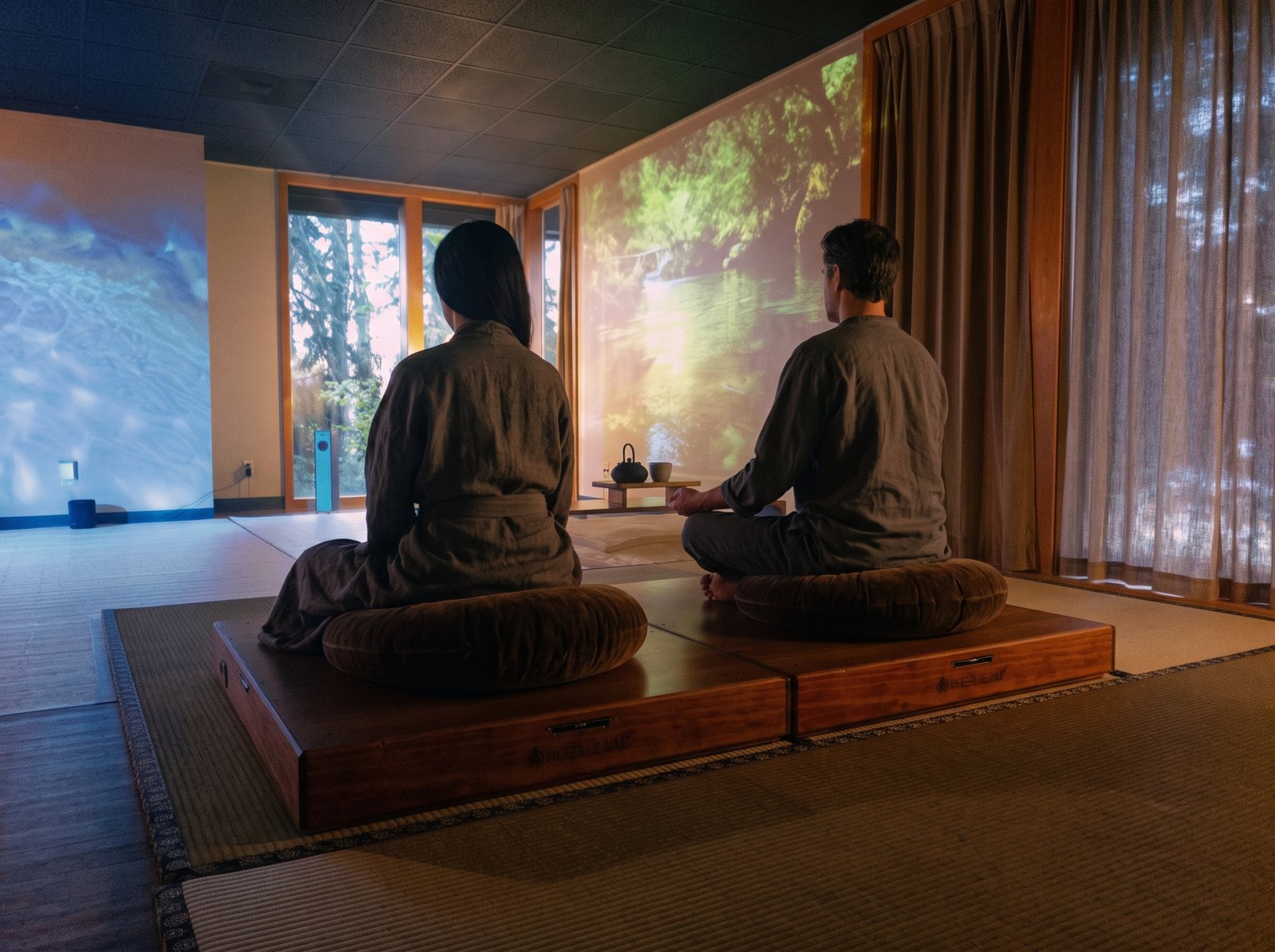
Two platform modules sit as a pair on the tatami: side by side for a couple, full length for one.
How the body registers vibration
When a vibrating surface contacts the body, the movement travels through skin, fascia, and bone and is detected by mechanoreceptors. Pacinian corpuscles are tuned specifically to vibration.
They convert physical force into nerve signals through mechanotransduction: mechanically sensitive ion channels open as tissue deforms, turning movement into electrical activity the nervous system can use. The same mechanism underlies touch, pressure, hearing, balance, and proprioception.
Why breathwork?
Breath is the one autonomic function also open to voluntary control, which makes it the only part of this the person themselves does. It is also the most direct access anyone has to their own interoceptive state.
What is established about breath
Slow, paced breathing has a well-established effect on cardiovascular and autonomic physiology. A large systematic review and meta-analysis covering 223 studies found that voluntary slow breathing increases vagally mediated heart rate variability during breathing, immediately afterward, and following repeated practice. (PubMed)
Around six breaths per minute is commonly used because it falls near the resonance frequency of the cardiovascular system for many adults. At this pace, breathing becomes strongly coupled with fluctuations in heart rate and blood pressure, increasing respiratory sinus arrhythmia and engaging the baroreflex, an important mechanism for regulating blood pressure. Individual resonance frequency varies, so six breaths per minute is a useful reference point rather than a universal optimum. (PubMed)
Slow breathing also changes the relationship between respiration, cardiovascular activity, and the nervous system. Reviews have found changes in heart rate variability, respiratory sinus arrhythmia, and other measures of autonomic regulation, along with changes in central nervous system activity. (PubMed)
Tap outside to close
The Deep Reset Chamber
Design
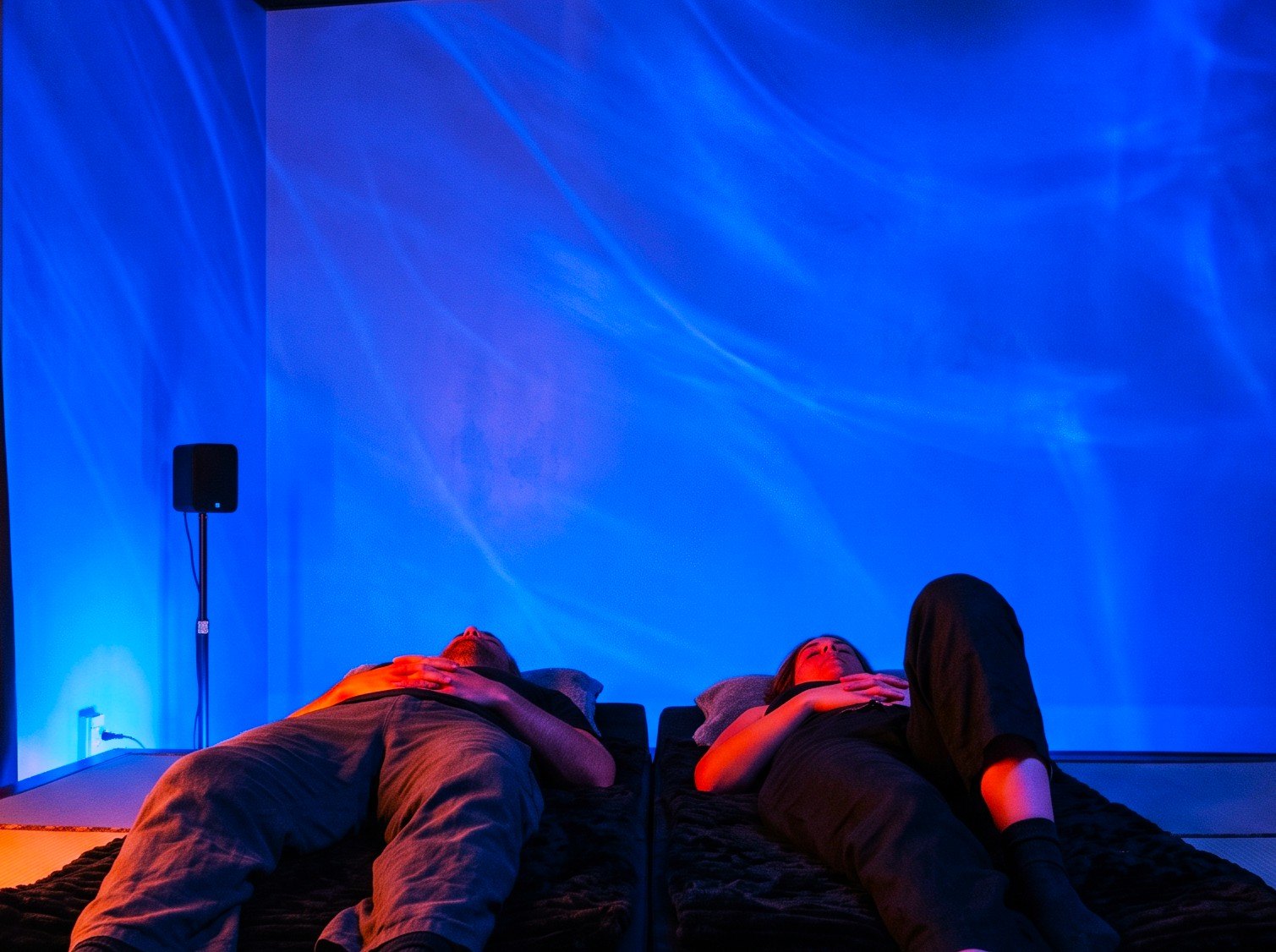
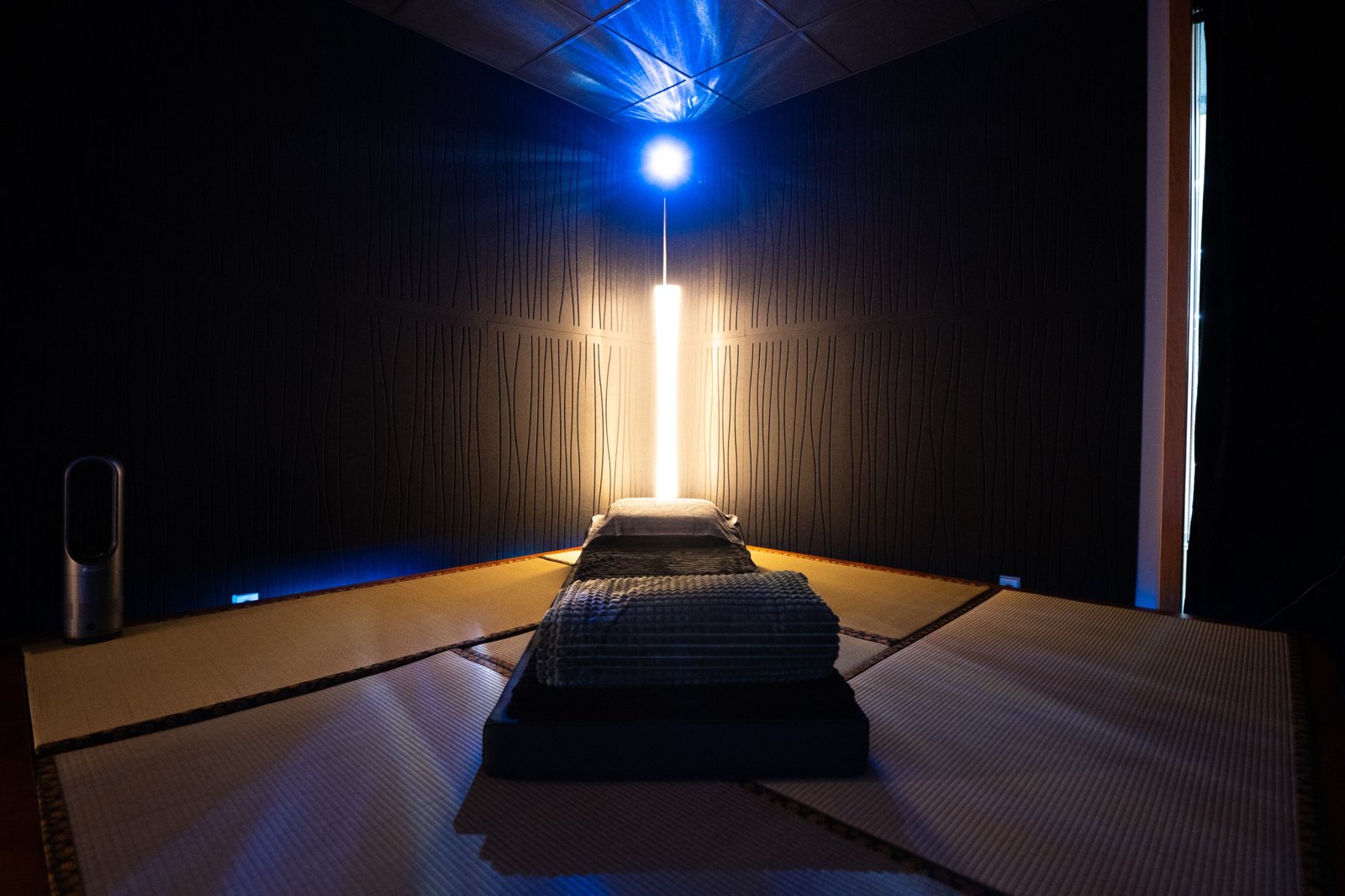
An acoustically treated chamber that envelops you in a sound and visual field. A vibroacoustic futon on tatami, set diagonally between two felt-lined walls, under a blue wave projection.
Function
Black acoustic felt panels. Absorb environmental sound: reduced sensory stimulation.
Blue wave projections. A slow pace that cues the body to slow down.
Stereo speakers at ear level. An immersive sound experience in an enveloped sound field.
Vibroacoustic futon. Small transducers inside, soft blankets, low-frequency sine waves (30–120 Hz): tactile entrainment.
Tap outside to close
Depth · Fluid Flow · Vibration · Immersion
Dynamic Atmosphere
Design
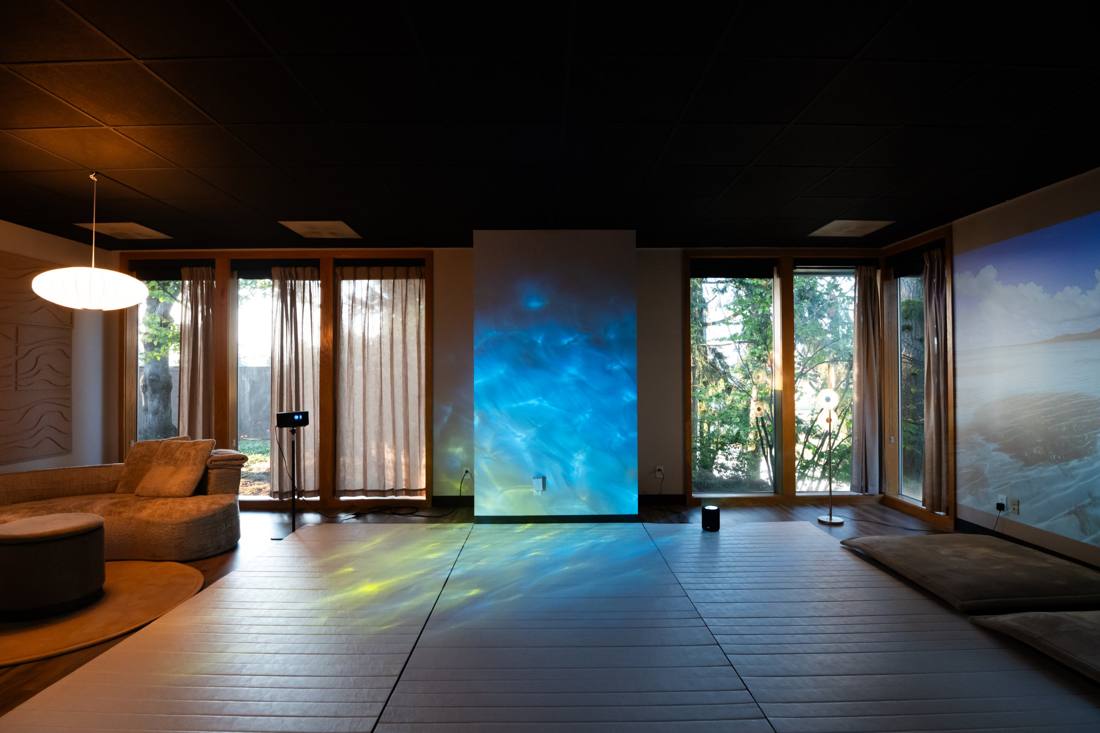
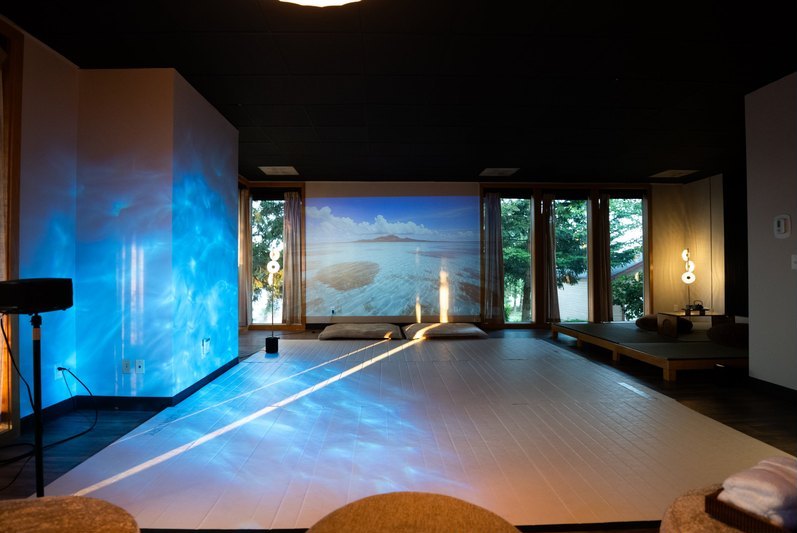
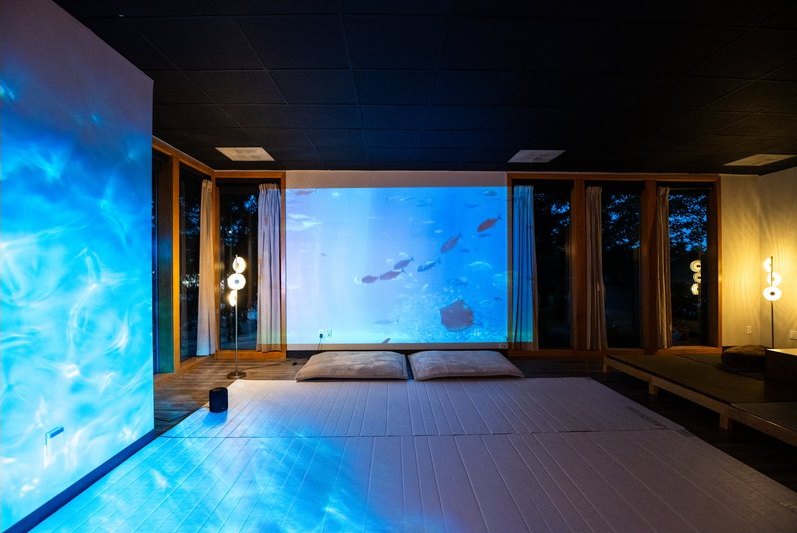
The open space after the chamber. Light comes up slowly; you sit on a woven rice-straw tatami platform facing moving water projections across the wall and floor.
Function
Aerospace-grade tactile transducers. Originally engineered for military and commercial flight simulators; they turn sound into physical resonance through bone and tissue.
Tactile sound guided breathwork. A singing-bowl sound bath through the platform flows into a two-tone breathing rhythm at about six breaths a minute, then back into the sound bath.
Paired platforms on tatami. Side by side for a couple; full length for one.
Water projections. Slow, continuous movement across the wall and floor: a visual anchor without demand.