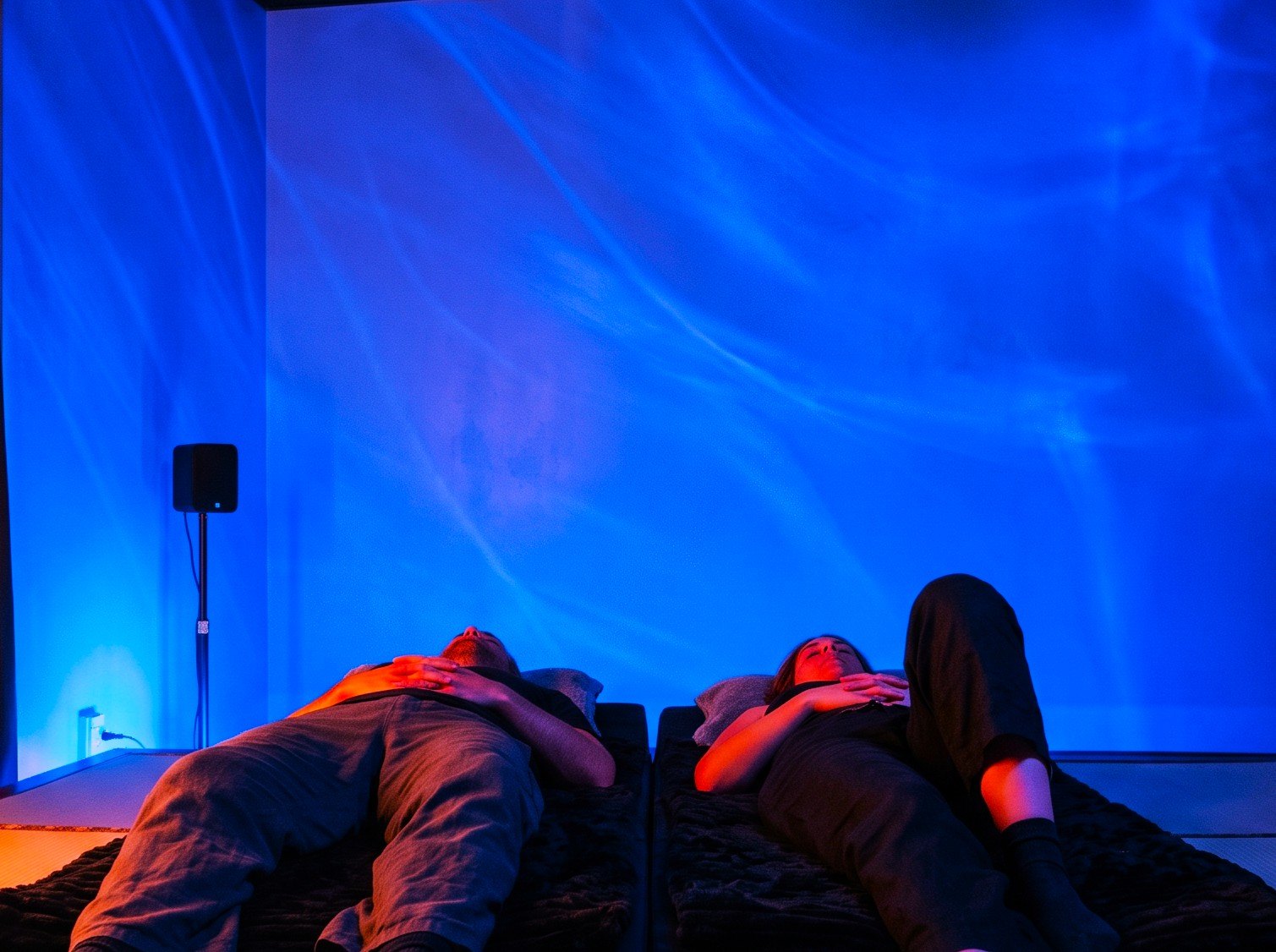
Dual vibration devices

Two acts, two environments,
two devices, two people.

Vibrotactile guided breathwork · active
The vibrotactile platform

A modular floor unit uses bone-conduction transducers to convert a slow, two-tone singing bowl tone into vibration felt through the platform.

Learn more
Why breathwork?

Breath is the one autonomic function also open to voluntary control, which makes it the only part of this the person themselves does. It is also the most direct access anyone has to their own interoceptive state.

What is established about breath

Slow, paced breathing has a well-established effect on cardiovascular and autonomic physiology. A large systematic review and meta-analysis covering 223 studies found that voluntary slow breathing increases vagally mediated heart rate variability during breathing, immediately afterward, and following repeated practice. (PubMed)

Around six breaths per minute is commonly used because it falls near the resonance frequency of the cardiovascular system for many adults. At this pace, breathing becomes strongly coupled with fluctuations in heart rate and blood pressure, increasing respiratory sinus arrhythmia and engaging the baroreflex, an important mechanism for regulating blood pressure. Individual resonance frequency varies, so six breaths per minute is a useful reference point rather than a universal optimum. (PubMed)

Slow breathing also changes the relationship between respiration, cardiovascular activity, and the nervous system. Reviews have found changes in heart rate variability, respiratory sinus arrhythmia, and other measures of autonomic regulation, along with changes in central nervous system activity. (PubMed)

Why vibration quiets the thinking mind

The thinking mind is constantly processing thoughts, memories, plans, language, and images.

Vibration is the bridge back to the body. Felt directly through the skin, muscle, and tissue, it gives attention a clear sensory signal to follow.

As attention moves from thought into sensation, mental activity becomes less dominant. The mind has somewhere else to go.

Vibration is the bridge from thought to sensation.

What mechanical coupling means

Mechanical coupling is the physical process by which vibration in the environment is transmitted into the body.

When a vibrating surface contacts the body, its movement is transferred through the skin and underlying tissues. The resulting mechanical deformation is detected by specialized sensory receptors called mechanoreceptors, which convert that physical movement into neural activity. This conversion is known as mechanotransduction. Mechanotransduction is the process by which cells convert mechanical forces into electrical or chemical signals.

The nervous system cannot directly "read" physical movement. When tissue is stretched, compressed, bent, or vibrated, that mechanical force changes the shape or tension of specialized sensory cells. Mechanically sensitive ion channels in those cells can respond to that deformation, allowing charged particles to flow across the cell membrane and changing its electrical state.

In sensory systems, this provides the first step from physical movement to neural information. A vibration can deform tissue; that deformation changes the activity of mechanosensitive receptors; the resulting electrical signals are transmitted through sensory neurons and eventually processed by the nervous system.

This mechanism underlies several forms of sensation, including touch, pressure, vibration, hearing, balance, and proprioception.

Mechanotransduction is therefore the biological conversion of mechanical energy into information that the nervous system can use.

Vibroacoustic therapy · passive
The vibroacoustic futon

A padded futon on a tatami platform contains evenly distributed transducers that deliver a gentle vibration of low-frequency sine waves, roughly 30–120 Hz, across the body via mechanotransduction.

Learn more
What is vibroacoustic therapy?

Vibroacoustic Therapy (VAT) is a therapeutic method that uses low-frequency, sinusoidal sound waves to transmit vibration directly into the body through specialized transducers. In this approach, the sine wave itself is the therapeutic stimulus.

Today, VAT is a recognized complementary therapeutic modality with a growing body of clinical experience and scientific research. Its defined methodology and decades of development provide a foundation for practitioners using sound and vibration as therapeutic tools.

The sound is converted by transducers into mechanical vibration, allowing frequencies to be experienced directly through the body. Frequency, intensity, modulation, and duration can be precisely controlled. VAT has been used and studied in relation to relaxation, stress regulation, pain, physical rehabilitation, and neurological function.

Sessions at Origin MindsOrigin Minds™ Sensory Compositiona proprietary salutogenic design framework → read are conducted by a certified vibroacoustic therapy practitioner.

Development of vibroacoustic therapy

VAT emerged from the pioneering work of Norwegian educator and therapist Olav Skille in the 1970s and early 1980s. His development of the "Music Bath" and subsequent work established the foundations of the method, including the use of low-frequency sine waves and controlled amplitude modulation.

→ The history of vibroacoustic therapy
→ Olav Skille and vibroacoustic therapy research
→ Research literature on vibroacoustic therapy

Why couple with the sensory space

Vibration is never experienced in isolation. Without a composed environment, light, sound, temperature, movement, texture, and space can compete with the signal.

A composed sensory space does not add sensation for its own sake or remove it to create deprivation. It tunes each condition around the vibration, so the environment does not interrupt the experience.

The aim is not sensory intensity. It is sensory coherence. Each element is given the right level, rhythm, and relationship to the others, creating a field in which vibration can remain the most salient signal.

The environment is part of the therapy. It creates the conditions for attention to settle into the body and stay there.

A dual system

Each of the dual devices is built for a dual of people, so a couple session is an option.

Learn more about the sensory space →

Practical questions, what to wear, where to park, what it feels like, are answered in the Q&A. Anything else, text me.