Q&A
QuestionsShort answers, in the order you'll need them.
If yours isn't here, text me.
I'm in session most of the day, so a text reaches me
faster than anything else, and I answer them myself.
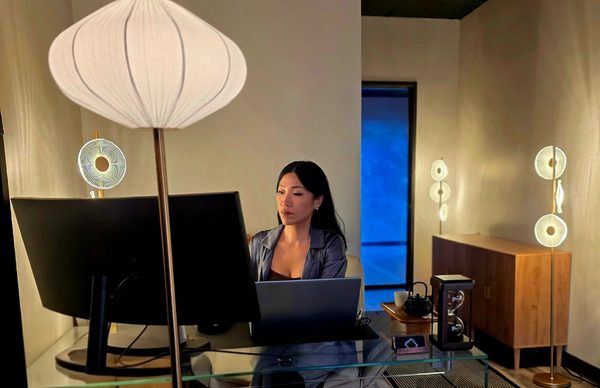 Meet Everest Laina
Q&A
If yours isn't here, text me.
I'm in session most of the day, so a text reaches me
faster than anything else, and I answer them myself.
Meet Everest Laina
Before you come
You pick a session and book it. There is no intake visit first.
The simplest way in is the Intro: $75 for two solo sessions, or one session for a couple. Each session is 45 minutes in The Deep Reset Chamber, on the vibroacoustic futon. For more, add the Private Customized Atmosphere when you book, as the Mind Reset add-on. It is 30 more minutes: you move into the Dynamic Atmosphere for immersive breathwork, carried by a tactile sound bath, and the whole studio is yours for the visit. With the add-on a visit runs 75 minutes in all.
Coming with someone works the same way. Couple Sessions have their own page, reached from the front door.
A few health questions are on the booking form, and I read them before you arrive. If you'd like your settings kept for next time, the scenery, the sound, the frequency, say so afterward and I'll note them.
Every session begins in the chamber. The longer you stay, the further it goes.
Yes, and it isn't the same session with a second person in it.
Both rooms are built with paired platforms, so you're side by side the whole time either way. What changes is what the session is arranged around. On your own it works on your state: physical tension, and a body brought out of a high-alert state. Together it works on the state between you: a shared rhythm first, then attunement.
Intro is $75 for two solo sessions or one couple session. After the Intro, a regular couple session is $120. Members start at $31.25 per session and get 20% off. The Private Customized Atmosphere add-on is 30 minutes and $45 more for one person, $65 more for a couple.
The add-on for two is the one people book for an occasion. You choose the environment together, and a song that means something to you both can end it.
Loose and comfortable. This one matters more than it sounds.
You'll be sitting cross-legged on a tatami platform, then lying flat for forty-five minutes. Anything tight at the waist, chest, or shoulders keeps pulling your attention back to it, and attention is the whole currency of the session.
If you're coming straight from work and can't dress for it, that's completely normal. Just text me that you'll need to change, and come 10 minutes early. The earlier you tell me the better, so I can have everything ready. A text on your way is enough.
There's a bathroom to change in, and I keep clean sets and new socks at the studio.
Nothing. It's all here.
Fresh socks. Warm steam towels, organic lavender or tangerine. Tea or water, your flavor and your temperature. A blanket for the futon. A soft earplug for the platform. A cold towel at the end.
You'll take your shoes off at the door. There's a bench at the entrance for your coat and bag and a cabinet for shoes.
Your phone stays at the entrance with your coat and shoes, silenced. Your things are safe.
Silent is the one thing I'd ask you to hold to: every notification is something unfinished, and the session is arranged to set exactly that down.
If you're on call, or waiting on something you truly can't miss, text me beforehand and we'll work something out.
2115 S 56th St, Suite 405, Tacoma. Free lot at the building, ground-level entrance, no stairs.
Come right at your appointment time rather than early.
The one exception is if you're changing here. Text me, and come 10 minutes early.
Booking is online, and payment is taken when you book.
For a refund I need 24 hours' notice. To move or cancel, text me. Don't call and don't email. I'm in session most of the day with my phone away, and a text is the thing I'll see between clients.
Comfort add-ons are offered in the booking flow rather than on the page, so you'll see them as you go.
If something happens inside the 24 hours, text me anyway. I'd much rather know.
The studio is located at 2115 S 56th St, Suite 405, in Tacoma with a free dedicated surface parking lot.
During the session
Every session begins in The Deep Reset Chamber. Come alone or with the person you came with.
45 minutes · The Deep Reset Chamber. Blanket, vibroacoustic futon, continuous low vibration through the mattress. Blue wave projection, sound at ear level, felt on the walls. Forty-five minutes.
Add-on · 30 minutes · Private Customized Atmosphere. The whole studio is made private for your visit, with a call button I answer. Light comes up slowly and you move to the tatami platform in the Dynamic Atmosphere, where a tactile sound bath rises through the platform and becomes the rhythm your breath moves with, about six breaths a minute. Warm tea after every session.
With the add-on a visit runs 75 minutes in all. Booked for two, it runs as a shared rhythm in the chamber, then mutual attunement in the atmosphere you choose together. The breathwork is paced for both of you at once.
Solo sessions →One thing: breathe.
The singing bowl rises through the platform, slows into two tones, and your breathing moves with it. The platform gives the instruction.
That's the only active part of the session. The forty-five minutes on the futon asks nothing of you at all.
No. Full sessions are completely non-verbal, zero-demand environments.
There is no small talk, no conversational debt, and zero performance required. The practitioner stays quietly at the room’s edge.
Being asked to respond or explain yourself is the very load we are setting down.
A deep, muted hum. Nothing percussive, nothing sharp, nothing that jolts — and the two instruments feel like two different things.
Like sitting inside a singing bowl. The transducer drives the resonance through the frame while you hear it through the bone, as one event. It gathers into two slow tones for the breath, then opens back out.
A gentle pulse that scans slowly across the body: pausing, rising, easing. Dull and muted, felt deep inside rather than on the skin. Nothing shakes — the futon moves, and you move with it.
The first minute can feel unfamiliar; few people have ever felt sound inside their own body. That settles quickly. Too strong or too faint — lift a hand, and it changes in a second. And if you fall asleep on the futon, that's common and completely fine: nothing is missed, and the last part of the session brings you back gently.
Afterward, and coming back
Most people are slow and quiet for a while. Some feel clear and awake, some feel heavy.
You're fine to drive. I'd give yourself a little room afterward rather than going into something demanding: a walk, a meal, an errand you're not in a hurry about. Nobody's waiting for the room, so take your time.
Ask me. I'll suggest a rhythm based on what you're coming in for, and we adjust it as we go.
What I'd steer you away from is coming whenever it happens to occur to you. The nervous system runs on prediction, and it builds its expectations from what recurs, so a schedule it can anticipate does more than the same number of sessions scattered at random.
What this is
Private vibro-sensory sessions.
You rest on instruments that translate sound into low-frequency vibration, which you feel directly through the body. The room is designed around that signal: light, sound, temperature, and texture are coordinated to reduce competing input and keep attention anchored in bodily sensation.
A continuous, salient physical sensation gives attention something concrete to follow, while the surrounding environment is controlled rather than demanding. The intended result is not “feeling relaxed” in the conventional sense. It is a temporary reduction in the amount of information your mind has to interpret, with attention shifted toward direct bodily sensation.
A private micro-retreat and sensory reset suite in Tacoma. You rest on Japanese tatami and futon platforms that transmit low-frequency sound directly through your body as gentle vibration, while the room is acoustically and visually composed to eliminate competing glare, noise, and demand. It gives your mind permission to stop anticipating and your nervous system permission to unbrace.
How the vibration works is on Vibro. How the sensory environment is composed is on Sensory. Why cognitive and sensory load matter is on Nervous System.
No. This is a 100% clothed, touchless somatic session.
The practitioner does not touch you. The only physical contact is the floor platform you sit on and the padded futon you lie on.
Sound frequencies resonate through your musculoskeletal frame, giving you deep-pressure physical grounding without hands-on manipulation or small talk.
No, though the comfort is genuinely shared. Steam towels, tea, quiet, a whole session with nothing asked: all of that is part of a session here.
Two things are not part of a spa. There is no breathwork, and there is nothing vibro-sensory: no transducer in the surface, and nothing transmitting a signal into the body by contact.
The aim differs as well. A spa arranges comfort as the destination. Here, comfort is one condition among several, arranged toward a session in which there is less to interpret, anticipate, and resolve.
It’s a tactile sound bath: the singing bowl goes through aerospace-grade transducers, originally engineered for military and commercial flight simulators, in a platform you sit and lie on.
In a regular sound bath the sound travels through the air and almost all of it bounces off the skin. Here it moves through bone and tissue at full strength, felt through the whole body.
Alone or as a couple.
No. Both use instruments; the framework is different.
Recovery technology measures, intervenes, and aims the body at a target.
Origin Minds™ works from salutogenesis, which asks what conditions keep a living system well and answers by arranging the conditions. Nothing is measured against a target and nothing is driven. The ground is prepared, and the growing is the person's own work, on their own timing.
No. Float tanks remove all sensory input, which can cause an overactive mind to scan the void and loop in racing thoughts.
Origin Minds is a fully clothed, dry float alternative. We dial down background noise and glare, but provide steady tactile vibration and slow water-light movement so your attention has an effortless place to land.
Deep somatic grounding without salt water, damp clothes, or claustrophobia.
No. It is a different kind of work, and the difference is worth stating exactly.
Counseling and psychotherapy work top-down, through language: what a person expects, what they understand about it, and what they do with it now. Psychiatry and clinical medicine identify a condition and treat it, with a licensed practitioner responsible for the course of care. This is skilled work, and it is licensed for good reason.
Origin Minds™ works bottom-up, on the conditions. It does not diagnose and it does not treat.
The two are not in competition. Deeper work lands better on settled ground.
No. None of it is needed in the room.
The hour doesn't work through understanding. It's a set of conditions, and conditions don't have to be interpreted in order to be conditions.
Nervous System and The Salutogenic Model are there because some people want the whole account. If that's you, it's all there. If it isn't, just come.